






Only 1 in 8 Younger Buyers Trust the System — Real Estate Has a Trust Problem
I came across a statistic recently that stopped me in my tracks.
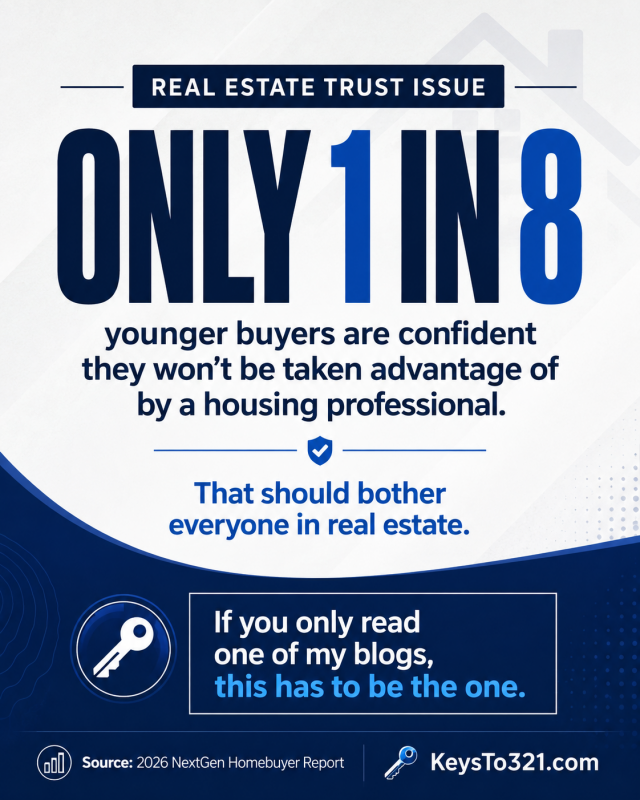
Only 1 in 8 younger homebuyers are confident they won't be taken advantage of by a housing professional.
I thought that couldn't possibly be right.
So I checked.
It is.
The 2026 NextGen Homebuyer Report, authored by Kristin Messerli and produced in partnership with FirstHome IQ and National MI, surveyed 1,000 Americans between the ages of 18 and 44 in January 2026. The group was almost evenly divided between homeowners and non-homeowners.
And the trust numbers are difficult to ignore.
Buyers Don't Necessarily Question Our Knowledge
Here's what makes the research especially interesting.
63% believe housing professionals have enough knowledge to provide good advice.
Yet only:
37% believe those professionals will put the client's interests ahead of their own.
Think about that for a minute.
The majority of younger consumers aren't necessarily saying real estate agents and mortgage professionals don't know what they're doing.
They're questioning whose interests we're looking out for when we do it.
That's an entirely different problem.
It's not a competence problem.
It's a trust problem.
The Number That Bothers Me Most
Among people surveyed who don't currently own a home, just 27% believe a housing professional will put their interests first.
But this number may be even more troubling:
Only 25% of non-homeowners believe a housing professional will recommend what's best for them if doing so means the professional earns less money.
One in four.
As someone who has spent years in this business, I don't think the proper response is to become defensive.
I think we should ask ourselves why consumers feel this way.
Because trust isn't something our industry is entitled to simply because we have a real estate license.
We have to earn it.
What Are Buyers Afraid Of?
The study dug deeper into that distrust.
Approximately:
-
60% worry about being taken advantage of.
-
57% worry they won't be told about better options.
-
58% fear being pressured into decisions they don't completely understand.
Those aren't insignificant concerns.
Buying a home may involve hundreds of thousands of dollars, contracts, inspections, financing, insurance, appraisals, negotiations and decisions most consumers make only a handful of times during their lives.
Meanwhile, the professionals helping them may participate in these transactions every day.
That creates an enormous imbalance in knowledge.
And when someone knows considerably more about a transaction than you do, you have to trust that they're using that knowledge for you rather than against you.
A Buyer's Agent Should Be Willing to Tell You Not to Buy
I've always believed something very simple about representing buyers:
Sometimes my job is to help you buy a house. Sometimes my job is to stop you from buying the wrong one.
Those two responsibilities are equally important.
If I see something that concerns me, I should tell you.
If I think you're overlooking a potential problem, I should tell you.
If we're discussing a house and I think there may be a better option, I should tell you.
If walking away from a transaction is the right decision for you, I should be willing to say so — even though nobody earns a commission when you don't close.
That's the job.
The Same Standard Applies to Sellers
This isn't exclusively a buyer issue.
If I'm sitting at your kitchen table discussing the sale of your home, my job isn't to tell you whatever I think will get the listing.
Sometimes the truth isn't the answer a homeowner was hoping for.
Maybe the home isn't worth what another agent promised.
Maybe an expensive improvement you're considering won't generate enough return to justify doing it.
Maybe the highest offer isn't actually the strongest offer.
Maybe reducing the price is the smartest move.
And occasionally, maybe selling right now isn't the best decision at all.
If my advice changes depending on which answer makes me the most money, then I'm not really advising you.
I'm selling you.
There's a difference.
Consumers Have More Information Than Ever — But That Doesn't Automatically Create Confidence
Today's buyers can research neighborhoods, listings, mortgage rates, property histories and virtually every part of the homebuying process before ever contacting an agent.
They're also increasingly using YouTube, social media and artificial intelligence to educate themselves.
The same 2026 study found YouTube and AI among the leading resources younger consumers use when researching homeownership. Yet real estate agents remain the first call for many people considering a purchase.
That tells me consumers don't necessarily want to eliminate the professional.
They want a professional they can trust.
Those are very different things.
Maybe Our Industry Should Stop Asking Consumers to Trust Us
Maybe we should start giving them reasons to.
Explain the contract instead of rushing through it.
Discuss the downside along with the upside.
Tell clients what could go wrong.
Give them alternatives.
Encourage questions.
Say "I don't know" when you don't know.
Tell them when another professional should answer the question.
Don't manufacture urgency where none exists.
Don't push someone into a higher-priced property because the commission might be larger.
And be willing to recommend a decision that may mean you don't get paid.
Those things don't belong in a marketing slogan.
They should simply be how the job is done.
Trust Should Come After the Evidence
I don't expect someone to trust me simply because I'm a Realtor.
You shouldn't.
Ask questions.
Challenge the advice you're getting.
Ask why.
Ask what alternatives exist.
Ask what the person advising you has to gain.
And pay attention to whether your agent is comfortable answering those questions.
A good real estate professional shouldn't be threatened by an informed client.
They should want one.
The statistic that started this article — only 1 in 8 younger buyers being confident they won't be taken advantage of by a housing professional — should bother everyone in this industry.
It bothers me.
But telling consumers they're wrong isn't going to fix it.
We fix it by earning back their trust, one client and one decision at a time.
If you're thinking about buying or selling a home on Florida's Space Coast and you want straightforward information before you make a decision, let's talk.
No pressure. No obligation. Just an honest conversation about your options.
Time to Change Your Latitude.
Source: 2026 NextGen Homebuyer Report by Kristin Messerli, in partnership with FirstHome IQ and National MI.