






For some Florida homebuyers, three letters can kill their interest in a property almost instantly:
HOA.
“I don’t want anyone telling me what I can do with my house.”
“I’m not paying somebody every month just to live there.”
“I’ve heard too many HOA horror stories.”
I understand the reaction. There are poorly managed homeowners associations. There are communities with rules that may be far too restrictive for a particular buyer. There are HOA fees that don't provide enough value, and there are associations whose finances deserve a very close look.
But automatically eliminating every Florida home with an HOA can also eliminate some very good homes and neighborhoods.
The better approach is simple:
Don’t decide whether you want an HOA until you know what that particular HOA actually does, costs and requires.
First, Not All Florida HOAs Are the Same
This is probably the biggest misconception.
An HOA could be a relatively inexpensive association that maintains an entrance sign and a few common areas.
Another might maintain:
-
A community pool
-
Clubhouse
-
Playground
-
Fitness center
-
Walking trails
-
Private roads
-
Gates
-
Landscaping of common areas
-
Lakes or retention ponds
-
Recreational facilities
Some communities have extensive architectural standards. Others have fairly basic rules designed primarily to maintain the neighborhood.
So asking, “Does this house have an HOA?” really isn't enough.
The better questions are:
How much is it? What does it include? What are the rules? And does it fit the way I want to live?
That HOA Fee May Be Paying for Things You Would Otherwise Pay for Yourself
Buyers understandably focus on the monthly or annual HOA assessment.
They should.
It is part of the cost of owning the home.
But don't stop at the number.
If one community charges $100 per month and another has no HOA, that doesn't automatically make the non-HOA home $100 per month cheaper to own.
What does that $100 provide?
Maybe it includes amenities you would otherwise pay to access somewhere else. Maybe it maintains common areas that contribute to the appearance of the neighborhood. Maybe it covers services or facilities that you would genuinely use.
That doesn't mean every HOA fee is a bargain.
It means the value matters just as much as the amount.
There Is Something to Be Said for Neighborhood Standards
This is where buyers sometimes have mixed feelings.
You may not want someone telling you what color you can paint your house.
Fair enough.
But you may also appreciate that your neighbor can't necessarily park six broken-down cars in the front yard, let the grass grow waist-high or make other changes that significantly affect the appearance of the surrounding homes.
Those are two sides of the same coin.
Restrictions that apply to your neighbor generally apply to you too.
For many buyers, particularly those purchasing in planned Florida communities, reasonable community standards are actually part of the appeal.
For others, they are absolutely not.
Neither buyer is wrong.
The important thing is knowing which buyer you are before you purchase the house.
An HOA Can Help Maintain the Overall Appearance of a Community
Drive through neighborhoods that were built 20 or 30 years ago and you can sometimes see a noticeable difference between communities that have maintained common areas and consistent standards and those that haven't.
That doesn't mean an HOA guarantees property values.
Nothing does.
But maintaining entrances, landscaping, amenities and community standards can help keep a neighborhood attractive.
And whether we like it or not, appearance matters in real estate.
It matters when you buy.
And someday, it may matter when you sell.
But You Need to Read the Rules
This is the part I would never tell a buyer to skip.
Before buying into an HOA community, understand the governing documents and restrictions.
Don't simply ask someone:
“Is the HOA strict?”
That's subjective.
Instead, look at the actual rules.
Depending on the community, they may address things like:
-
Boats and RVs
-
Commercial vehicles
-
Pickup trucks
-
Parking
-
Fences
-
Sheds
-
Exterior paint colors
-
Landscaping
-
Pets
-
Rentals
-
Holiday decorations
-
Home improvements
-
Architectural changes
If you own a 28-foot boat and want it sitting beside your house, finding out after closing that it isn't allowed would be a pretty significant problem.
The same applies if you're buying the property intending to use it as a rental and discover that the community has rental restrictions.
Know before you buy.
Look at the HOA's Financial Health Too
The rules aren't the only thing buyers should consider.
The financial condition of the association matters.
I want buyers to understand things such as:
-
The current assessment
-
Recent assessment increases
-
Any existing special assessments
-
Known or proposed future assessments
-
Association reserves
-
The annual budget
-
Major upcoming projects
-
Pending litigation when applicable
-
What the association is responsible for maintaining
A beautiful clubhouse isn't nearly as exciting if it needs a major repair and the association doesn't have enough money available to handle it.
A well-run association should be treated differently from an association that has financial or management problems.
Again, the issue isn't simply HOA or no HOA.
It's this HOA.
Florida Buyers Receive HOA Disclosures
Florida law requires a prospective buyer of a property subject to mandatory HOA membership to receive a disclosure summary explaining, among other things, that membership is required, restrictive covenants apply, assessments must be paid and special assessments may also be imposed.
That disclosure is important.
But I don't think buyers should treat it as the end of their investigation.
The disclosure tells you that an HOA exists.
Your due diligence should tell you whether you actually want to live under that particular association.
Don't Confuse an HOA With a Condo Association
This is particularly important in Florida.
A single-family home governed by a homeowners association is not automatically the same thing as purchasing a condominium.
Florida homeowners associations are generally governed under Chapter 720 of Florida Statutes.
Condominium ownership involves a different legal structure, different association responsibilities and different financial considerations.
So when someone says, “I won't buy anything with an association because of everything I've heard about Florida condos,” we need to separate those two conversations.
They aren't interchangeable.
Florida Has Also Tightened Some HOA Requirements
Florida lawmakers have made significant changes to HOA laws in recent years, including requirements involving association records, board responsibilities, financial practices and enforcement.
That doesn't mean every HOA will be perfectly managed.
It does mean buyers shouldn't rely entirely on stories they heard years ago when deciding whether to consider an HOA community today.
Evaluate the actual association in front of you.
When an HOA Probably Isn't Right for You
I wouldn't try to talk every buyer into an HOA.
If you want maximum freedom over your property, an HOA community might not be the right choice.
If you have an RV, boat, work vehicle or other equipment you want to keep on the property, restrictions deserve especially close attention.
If you strongly dislike architectural controls, approval processes or community rules, buying into an HOA and then fighting the association for the next ten years probably isn't going to make anyone happy.
There are plenty of Florida neighborhoods without mandatory HOAs.
We can look there instead.
But Don't Automatically Eliminate Them
This is the point I want Florida buyers to remember.
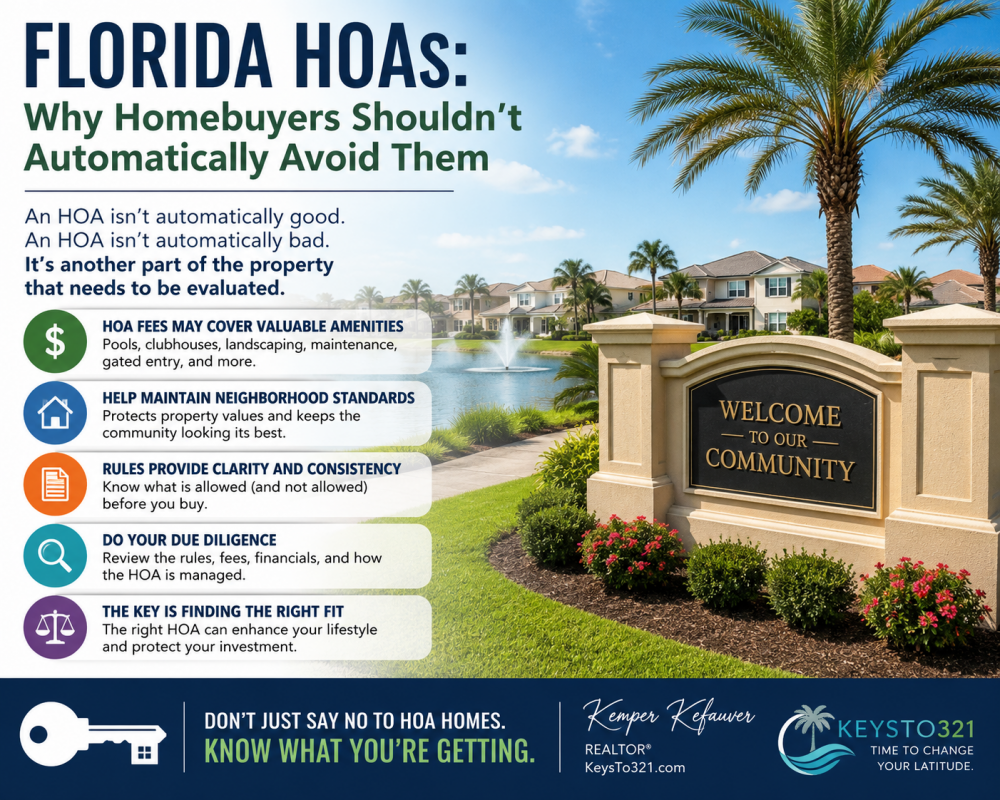
An HOA isn't automatically good.
An HOA isn't automatically bad.
It's another part of the property that needs to be evaluated.
I've always believed buyers should understand exactly what they're purchasing—not just the house itself, but the community surrounding it.
So before crossing an otherwise great Florida home off your list because you see an HOA fee, let's find out:
What does it cost?
What does it cover?
What are the restrictions?
How is the association managed?
And most importantly, does it work for the way you want to live?
You might still decide the answer is no.
And if you do, that's useful information.
But at least you'll be saying no to the actual HOA, rather than saying no because of three letters in the listing.
Thinking About Buying on Florida's Space Coast?
If you're considering a home in Merritt Island, Cocoa Beach, Rockledge, Viera, Melbourne, Titusville or anywhere else on the Space Coast, I can help you look beyond the listing photos and understand the things that will actually affect living in the home—including HOA fees, restrictions and community considerations.
The goal isn't to convince you to buy a particular house. It's to make sure you know what you're buying before you do.
Kemper Kefauver | KeysTo321
Time to Change Your Latitude.